
The Invisible Ache: Why You Are Secretly Furious at Your Job (And the Comforting Lie That Keeps You Trapped)
"The quiet desperation you feel on Sunday night isn't just standard work anxiety. It is the muffled scream of your hijacked sovereignty, warning you that you have traded your finite human freedom for a comforting fiction."
— Jeanette Larsen, Chief Business Catalyst at Evolve Business Systems
You Know the Feeling (Even If You Try to Ignore It)
It’s that low-grade, persistent hum of physical and mental tension that settles into your shoulders around 4:00 PM every single Sunday. It’s the sudden, hot flash of visceral resentment you feel when a manager asks you to complete an "urgent" task at the very end of the day. It’s the deep, bone-weary exhaustion that ten hours of sleep can’t seem to cure.
Most people write this off as standard workplace anxiety. They blame it on a bad boss, a demanding schedule, an understaffed department, or a temporarily stressful quarter. They tell themselves that if they can just get through this performance cycle, secure that next promotion, or find a slightly better company with a nicer breakroom and hybrid flexibility, the ache will finally go away.
But that is a comforting lie.
The anger you are carrying inside you isn’t actually about your heavy workload, your micromanaging boss, or your salary. The raw, vibrating sense of violation you feel when a gig platform cuts your pay or a corporate employer demands your absolute, round-the-clock obedience is actually an existential alarm system.
If you are asking yourself, "Why am I angry at my job?" the answer is simpler—and more terrifying—than you think. You are angry because, deep down, you know you have surrendered your career autonomy. Your mind is screaming at you to stop running the corporate con on yourself and take it back.
The Illusion of Job Security and the Rise of Workplace Anxiety
For generations, we have been conditioned to accept a grand social contract: trade your time, your autonomy, and your self-determination to an employer, and in exchange, they will provide you with safety, stability, and a predictable paycheck.
This transaction is the unquestioned foundation of modern employment. We walk into traditional W-2 jobs and contract agreements believing we are entering a safe harbor. We convince ourselves that "employee" is a safe state of being, protected by labor laws, corporate HR departments, and mutual loyalty.
But in the era of the Great Decoupling, this social contract has completely disintegrated.
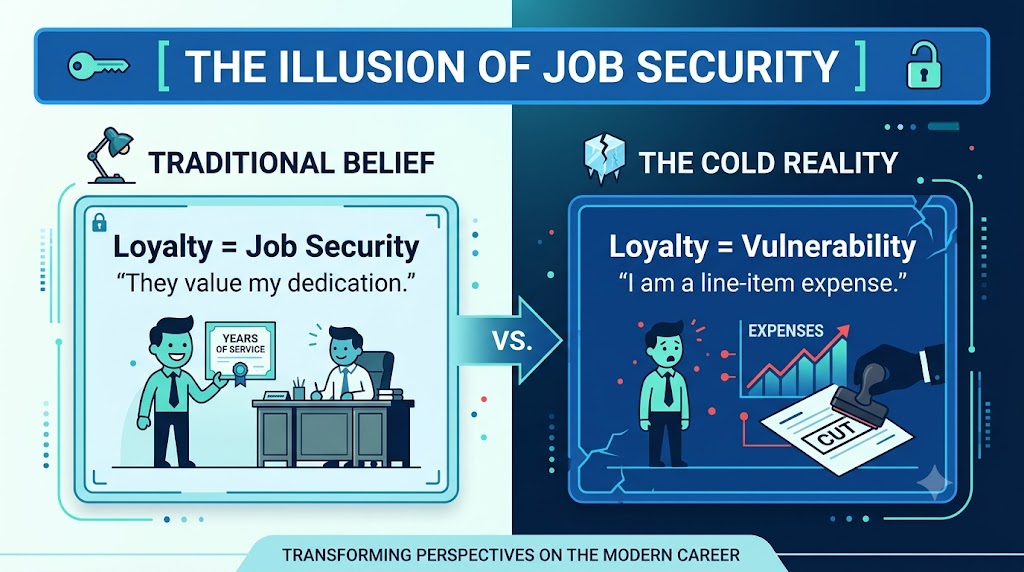
When a company experiences a minor dip in quarterly earnings, or when a new generative AI automation tool makes a support or marketing department redundant, the ledger is balanced without an ounce of human emotion.
●The loyal worker who gave ten years of their life, skipped family dinners, and answered emails on vacation is dismissed with a standardized, automated email and a generic severance package.
●The independent contractor who relied on a gig platform to feed their family is suddenly locked out of their dashboard due to an arbitrary algorithm change or a database glitch, with no human avenue for appeal.
When these betrayals happen, our immediate psychological response is to feel exploited, cheated, and deeply victimized. We scream about corporate greed, we label the platforms as "scammers," and we demand that regulators fix the system.
But if we pause and look at this dynamic with absolute psychological clarity, we must ask a devastating question: Why does this systemic betrayal hurt us so deeply in the first place?
It hurts because we have allowed ourselves to become dependent. The anger and violation you feel are the natural cognitive responses to realizing that you have handed the keys to your financial, emotional, and psychological survival to an entity that does not—and cannot—care about your humanity. This is the dark reality behind the job security myth.
The Psychology of Surrendered Autonomy: Why We Choose Helplessness
As human beings, our brains are hardwired to seek safety and avoid risk. From an evolutionary perspective, uncertainty equals danger. Therefore, when society offers us a pre-packaged pathway that promises to eliminate career uncertainty, we latch onto it with fierce intensity.
Unfortunately, this desperate desire to avoid risk leads directly to a debilitating psychological phenomenon known as learned helplessness.
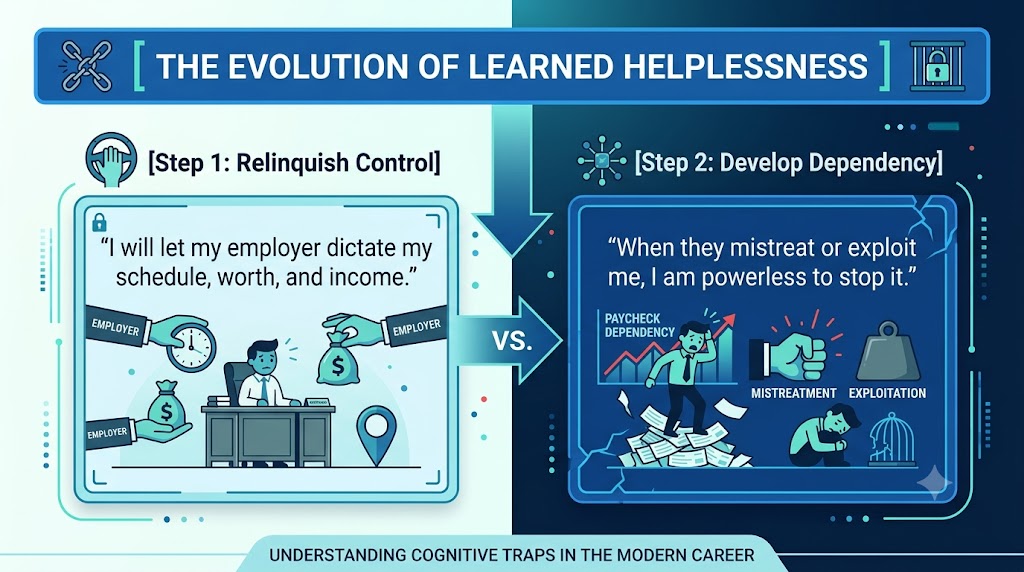
When you enter the workforce with a subservient mindset, you slowly outsource your internal locus of control. You allow an external corporate entity to determine:
1.What your finite, precious human time is worth per hour.
2.When you are allowed to see your family, eat, or sleep.
3.Whether your skills are highly valuable or suddenly obsolete.
4.How long your financial stability will last.
This voluntary captivity creates a profound state of cognitive dissonance. You want to believe you are an independent, self-actualized adult. Yet, your daily reality is that you must ask another adult for permission to take a day off, visit a doctor, or attend your child's school play.
To bridge this painful psychological gap, your mind runs a defensive con on itself. It tells you that this arrangement is "secure." It convinces you that sacrificing your career autonomy is a reasonable, necessary price to pay for a steady paycheck.
But your subconscious mind is not so easily fooled. The chronic workplace anxiety, the low-grade resentment, and the constant feeling of being undervalued are the direct psychological consequences of this self-deception. Your mind knows you are operating in a state of absolute, unguarded vulnerability, and it is trying to wake you up to why W2 employment feels like exploitation.
Exposing the Myth of the "Secure Position"
Let us shatter the ultimate myth of the modern workforce once and for all: There is no such thing as a secure position.
True security is never a job title, a W-2 salary, or a corner office gifted to you by an employer. To believe that an employer can give you security is to believe that a landlord can give you a home. At any moment, the lease can end, the terms can change, and you can be left standing on the curb.
When we look at the workforce today, we see millions of capable, intelligent people driving themselves to the brink of physical and mental exhaustion to protect jobs that could be automated or outsourced tomorrow. They cling to their tenure and their loyalty like shields, completely blind to the fact that modern corporate accounting treats their human effort strictly as a liability to be minimized.
If you are currently relying on a single employer or a single gig platform for 100% of your livelihood, you are not secure. You are highly leveraged, highly vulnerable, and completely exposed to the whims of decision-makers who do not even know your name. This is the heart of gig economy exploitation.
Your anger is not a pathology to be quieted with corporate mindfulness apps, mandatory mental health days, or empty platitudes about "work-life balance." Your anger is a righteous, necessary signal. It is proof that you still possess a spark of sovereignty that refuses to be completely domesticated.
Reclaiming Your Career Sovereignty: The Path of the Sovereign Professional
The only way to cure the invisible ache is to stop looking for a savior in the form of a better boss or a fairer corporate system. You must stop participating in the self-scam that trades your freedom for a counterfeit safety net.
You must step onto the path of reclaiming your career sovereignty and adopt a sovereign professional mindset.
Dependent Employee Mindset
Sovereign Professional Mindset
"Who will hire me?"
"What valuable business problems can I solve?"
"I need a secure paycheck."
"I am a self-contained Business of One."
Outsources personal accountability
Owns both the risk and the financial reward
Highly vulnerable to corporate exploitation
Highly insulated, diversified, and free
A Sovereign Professional is not a passive wage-earner who surrenders their identity to a corporate logo. Even if they choose to work within an organization as an employee, they operate with the mindset of an independent vendor—a self-contained Business of One. They understand that they are renting their specialized services to a client, not selling their human sovereignty.
To learn how to stop feeling helpless at work and transition from an anxious employee into a Sovereign Professional, you must commit to three radical shifts in consciousness:
1. Shift from Victimhood to Radical Accountability
The moment you blame an employer, a gig platform, or the macroeconomy for your lack of career control, you validate your own helplessness. A Sovereign Professional takes 100% ownership of their situation.
If a client or employer treats you poorly, cuts your hours, or breaches an agreement, you do not waste your energy screaming into the corporate void. You recognize that you allowed yourself to be in a position where they had the power to harm you. You adjust your risk management, strengthen your boundaries, and actively build a better exit strategy.
2. Build Your Own Professional Safeguards
If you operate a business, you do not rely on a single customer for 100% of your revenue, because you know that if that customer leaves, your business dies. You must treat your career with the same commercial rigor.
●Diversify your skill sets.
●Build multiple streams of income and value.
●Construct a robust, non-negotiable financial runway (an "Exit Buffer").
●Aggressively upgrade your personal brand outside of your company's walls.
When you know you can walk away from any agreement at any moment without financial ruin, your workplace anxiety vanishes, and your personal leverage sky-rockets.
3. Commit to the Success Triad
Sovereignty requires a systematic, proactive approach to life and work. You must activate the three elements of the Success Triad:
1.Vision: Define exactly what your sovereign life looks like. Stop letting corporate HR departments write your life goals for you.
2.Planning: Engineer a precise, tactical blueprint to move you away from absolute dependency and toward self-reliance.
3.Execution: Take daily, unrelenting, self-directed action to build your assets, master new skills, and construct your own professional freedom.
Stop Running the Con on Yourself
The system is not going to change. Corporations will continue to act in their own financial self-interest, gig platforms will continue to optimize their algorithms to pay the minimum possible rate, and the economic landscape of modern employment will continue to shift beneath our feet.
You cannot control the systemic shifts of the Great Decoupling. But you have absolute, total control over whether you choose to walk into the trap.
The next time you feel that familiar Sunday night dread, or that sudden surge of workplace anger, do not push it down. Do not reach for a temporary distraction to numb the trauma of modern employment.
Listen to the ache. Let it burn. Let it remind you that you were not born to be a compliant cog in someone else's machine.
Expose the con artist in your own mirror, reject the illusion of job security, and make the conscious, uncompromising decision to reclaim your sovereignty. Your career, your peace of mind, and your life belong entirely to you.
It’s time to start acting like it. Here's a tool to help you make the transition. It's a CRITICAL RESOURCE for readers of this blog. Get your copy FREE, by clicking on the link below:
The Career Sovereignty Audit Checklist
Are you ready to stop running the con on yourself and find out if your career is built on a foundation of sand?
Our exclusive Career Sovereignty Audit Checklist is a diagnostic tool designed by Evolve Business Systems to help you measure your professional dependency, calculate your financial escape runway, and map out your transition from a dependent employee to a highly paid, self-reliant Business of One.
Inside this free diagnostic checklist, you will discover:
●The Dependency Index: A quick quiz to score your vulnerability to sudden layoffs, corporate restructuring, and algorithmic pay cuts.
●The Runway Calculator: A step-by-step formula to calculate your actual "exit runway" so you know exactly when you can safely walk away from a toxic job.
●The Skill-Productization Framework: A simple guide to transforming your daily job description into a high-ticket, freelance service menu.
👉 CLICK HERE TO DOWNLOAD THE CAREER SOVEREIGNTY AUDIT Checklist & RECLAIM YOUR FREEDOM TODAY!