The Uber Driver Fallacy: Why "Loyalty" is a Lethal Career Strategy in the Era of the Great Decoupling
"Your employer does not have a soul, and a corporate ledger cannot measure your devotion. To expect security from an entity that views you strictly as an operating expense is to gamble with your financial survival." — Jeanette Larsen, Chief Career Catalyst, The Work-From-Home Revolution
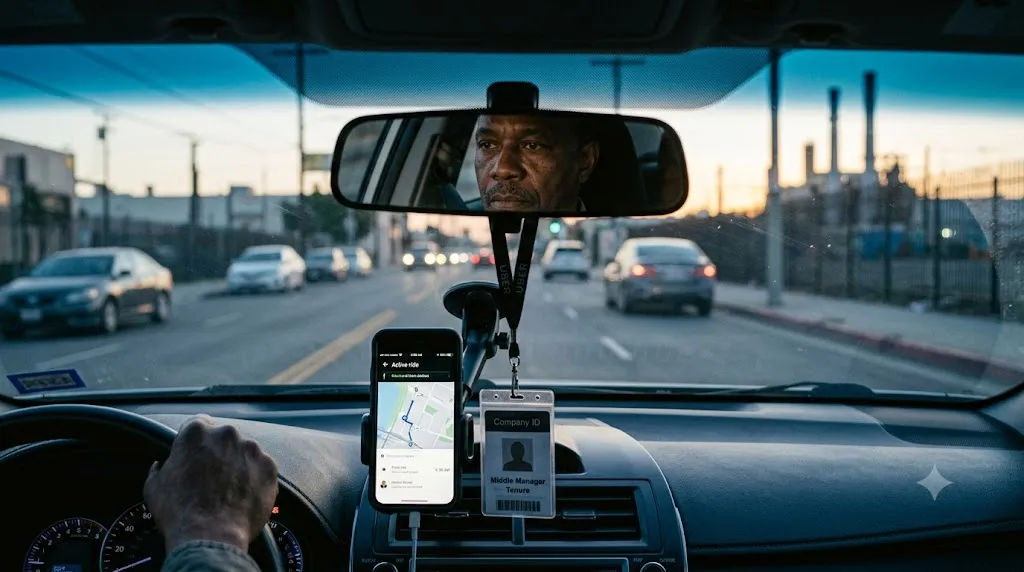
A few days ago, I had an eye-opening conversation with an Uber driver. Let's call him Marcus.
Marcus was incredibly polite, highly articulate, and clearly hardworking. As we navigated the early-morning traffic, our conversation turned to the modern economy, the rising cost of living, and what I call the Great Decoupling—the systemic breaking of the traditional contract between employers and workers.
When I brought up the rapid pace of AI integration and how it is quietly dismantling traditional job security, Marcus smiled warmly and shook his head.
"I hear what you're saying," he told me, adjusting his grip on the steering wheel. "But my full-time employer isn't like that. I've been with the company for several years. My manager knows me, they trust me, and my position is incredibly secure because of my loyalty and tenure."
It was a beautiful sentiment. It was also a terrifyingly dangerous delusion.
Because here is the cold, hard reality of Marcus’s situation:
He was driving an Uber. Despite his "secure, long-term career," he was moonlighting in the gig economy at dawn just to make ends meet.
He was a middle-manager in a support department. His job description had absolutely nothing to do with direct revenue generation for the company. He was, by definition, a corporate cost center.
Marcus is the poster child for what I call The Uber Driver Fallacy. He is a man running a massive psychological con on himself, fiercely defending the honor and "security" of a corporate system that underpays him, even as he drives rideshare to survive. He is relying on tenure and loyalty—two metrics that corporate accounting deleted from the ledger decades ago—to shield him from an economic storm he refuses to admit is coming.
In our first article, The Invisible Ache: Why You Are Secretly Furious at Your Job, we explored the raw, subconscious anger that arises when you realize you have surrendered your autonomy to an employer. Today, we must address the brutal economic mechanics that make that surrender so dangerous.
It is time to shatter the myth of corporate loyalty once and for all and understand why demanding "security" from an employer is the fastest way to destroy your own career sovereignty.
Meta-Description:
Discover why corporate loyalty is a dead strategy. Learn the truth about the Great Decoupling, the Uber Driver Fallacy, and how to build true career security.
Dismantling the Villain: Why Capitalism Isn't "Scamming" You
When workers are suddenly laid off after ten years of service, or when contract platforms arbitrarily slash pay rates, our default emotional response is moral outrage. We scream about "corporate greed." We call the executives "crooks." We complain that the system is a "scam."
But this is an emotional cop-out.
Let us be completely, philosophically clear: The company is not scamming you.
A corporation is not a moral agent. It is a legal and economic structure designed to do one thing: maximize value for its shareholders. It does this by generating revenue and minimizing expenses. In a capitalistic economy, this is not a betrayal; it is simply the rules of the game.
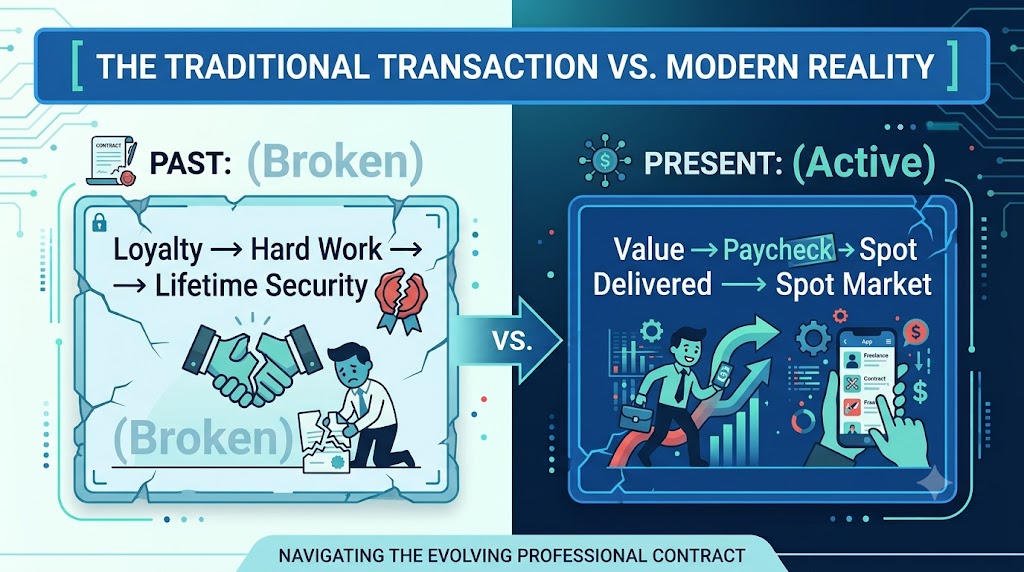
If your employment cost is greater than the value you generate—or if your job can be automated for 5% of your salary—you will be let go. Expecting a business to act against its own economic self-interest to preserve your feelings is like expecting the gravity to stop working because you tripped.
The game isn't rigged; you are simply playing with an outdated rulebook.
The Great Decoupling and the Death of the Support Role
We are living through the Great Decoupling—a rapid economic shift where business productivity and labor compensation have completely parted ways, driven by automation, global sourcing, and artificial intelligence.
In this new era, workers are divided into two distinct categories:
1. Revenue-Generators (Value Creators)
These are the individuals who directly bring money into the business. They write the code for the product, close the enterprise sales, or build the core proprietary technology. Because they are directly tied to the incoming cash flow, they have leverage.
2. Cost Centers (Support Roles)
These are the individuals who manage, coordinate, document, or support the revenue-generators. This includes middle-management, administrative support, HR coordinators, and standard customer relations.
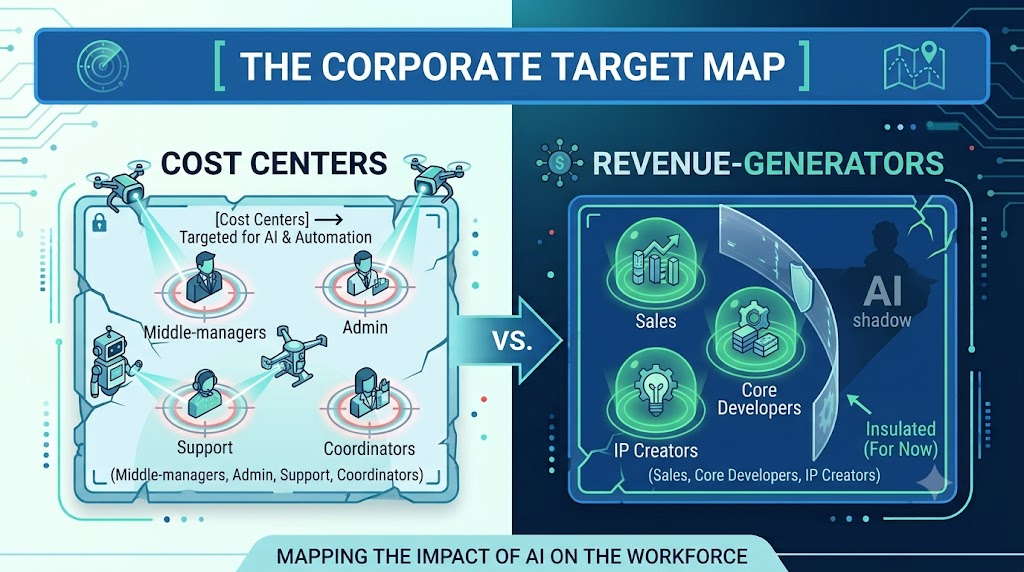
The tragedy of the Uber Driver Fallacy is that people in support roles are the most vulnerable to the Great Decoupling, yet they are often the most defensive of their "security."
Middle-management is the prime target for modern restructuring. When AI can draft reports, analyze team performance, schedule shifts, and track metrics automatically, the need for layers of human coordinators vanishes.
If your job description involves "monitoring," "coordinating," "processing," or "managing" other people's work without directly generating revenue, you are standing on a melting glacier. Your tenure will not save you. Your loyalty is irrelevant. The moment the technology becomes cheaper than your salary, you are gone.
The Reality of Career Sovereignty: Security is Built, Not Given
If there is no such thing as a secure position, how do you find peace of mind?
The answer requires a radical, psychological shift. You must accept that true security can never be given to you by an employer.
To believe that an employer can give you security is to believe that a landlord can give you homeownership. You are merely renting space. At any moment, the landlord can raise the rent, sell the property, or terminate the lease.
When you demand "job security" from a W-2 employer, you are placing the entire responsibility for your survival into their hands. You are outsourcing your agency. And that, as we discussed, is the ultimate self-scam.
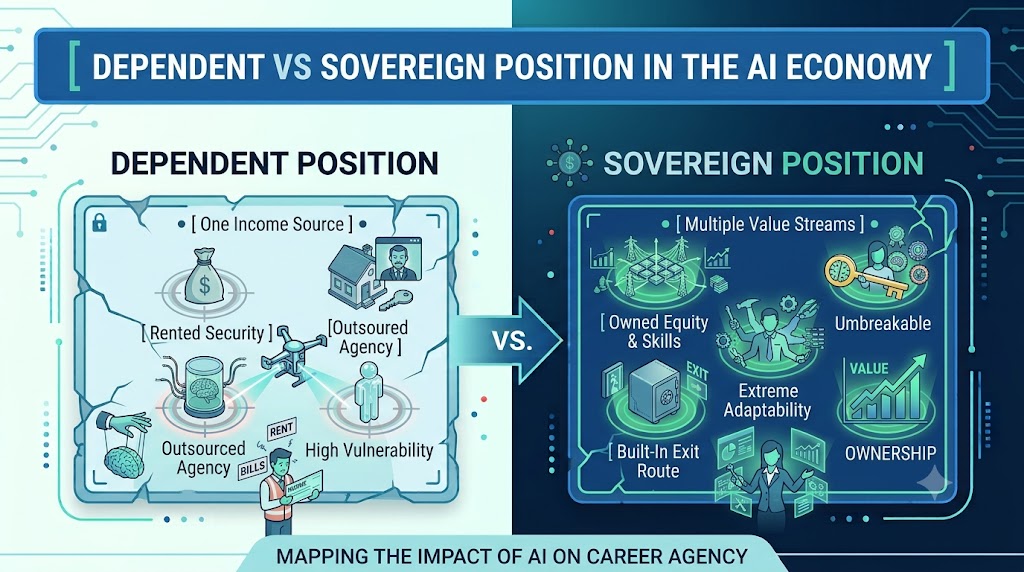
A Sovereign Professional does not ask an employer for safety. They create their own safeguards. They walk into every business arrangement knowing they are a "Business of One" renting a specific capability to a client. They maintain control of their time, their tools, and their exit strategy.
Take the First Step: Stop Scamming Yourself
Are you currently living out your own version of the Uber Driver Fallacy? Are you telling yourself that your company is "different," or that your tenure makes you irreplaceable, even as you work overtime or stress about your financial future?
It is time to strip off the comfort-driven blindfold and face the truth.
To help you audit your actual level of career vulnerability, we have created a powerful diagnostic tool: The Career Sovereignty Scorecard.
This brief, 10-question assessment will show you exactly how exposed you are to the Great Decoupling, help you identify your hidden career vulnerabilities, and give you a clear, personalized starting point to reclaim your economic power.
$$Click here to download your FREE Career Sovereignty Scorecard now.$$
Stop relying on the myth of corporate loyalty. The glacier is melting, but you don't have to sink with it. Reclaim your sovereignty, own your value, and start building a career that belongs entirely to you.