
The Con Artist in the Mirror: Exposing the Ultimate Self-Scam in Modern Employment
"The most dangerous con artist you will ever meet doesn’t wear a slick suit or sell fake cryptocurrency. They look back at you every morning from your bathroom mirror, whispering that your W-2 job is 'safe' just so you won't have to face the terrifying, beautiful weight of your own freedom." — Jeanette Larsen, Chief Career Catalyst, The Work-From-Home Revolution
We have all been there. You get a sudden, painful slap in the face from the economic reality of modern work.
Maybe you were shortchanged on your digital dashboard by an app-based platform that uses algorithms to squeeze labor for fractions of pennies. Maybe you watched a major platform arbitrarily lock you out of your account due to a system glitch, wiping out your week’s income with zero recourse. Or maybe you are a salaried corporate worker who woke up to a generic, pre-scheduled Zoom meeting where a robotic HR representative informed your entire department that your roles have been automated out of existence.
Your immediate, cellular reaction to these moments is hot, blinding rage. You feel violated. You scream into the void that these employers are "scammers" and "crooks." You demand that the government step in, that regulators write new laws, or that the system somehow becomes "fair."
In our first piece, The Invisible Ache: Why You Are Secretly Furious at Your Job, we explored the raw, subconscious anger that arises when you realize you have surrendered your life’s agency to an employer. In our second piece, The Uber Driver Fallacy: Why "Loyalty" is a Lethal Career Strategy, we analyzed the cold mathematical realities of the Great Decoupling and how support-role workers are sitting in the crosshairs of AI automation.
But today, we have to look past the external villains. We have to ask a terrifying, deeply philosophical question that most people spend their entire lives running away from:
If you willingly walk into a cage, lock the door, and hand the key to a stranger in exchange for a warm blanket and a bowl of soup... who actually scammed you?
The hard, liberating truth is this: the system isn't scamming you. You are scamming yourself.
The Anatomy of the Self-Scam: The Flight from Freedom
To understand why we scam ourselves, we must look at the psychological mechanics of the human ego. As a behavioral coach, I have watched thousands of highly intelligent, incredibly capable adults actively defend arrangements that degrade, underpay, and exploit them.
Why do they do it? Because accountability is terrifying.
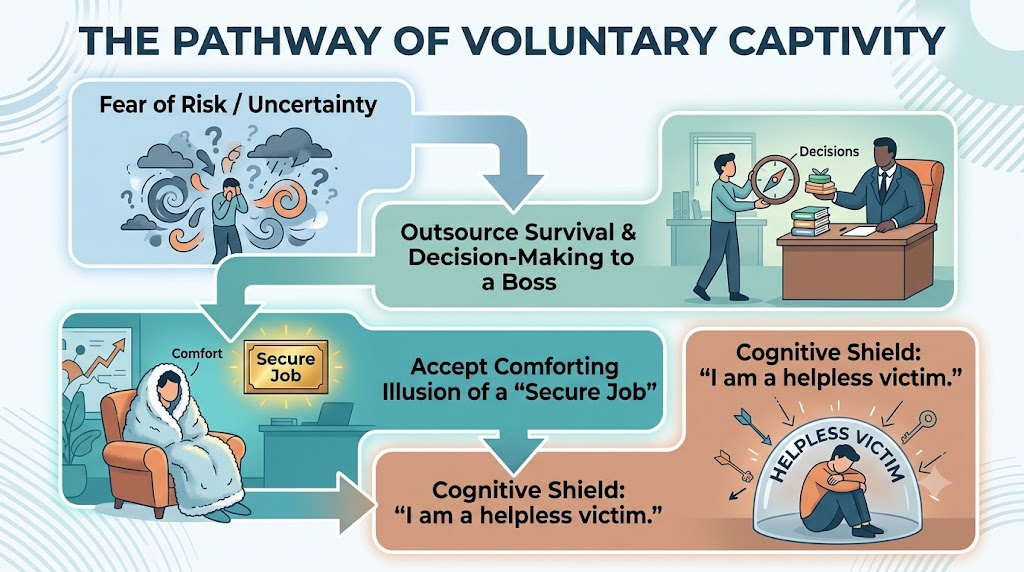
If you take 100% ownership of your financial, professional, and personal survival, you have no one left to blame. If your "Business of One" fails, if your skills become obsolete, or if your income drops, the responsibility rests squarely on your shoulders. That level of radical accountability requires a massive output of mental, emotional, and physical energy.
For the primitive human brain, uncertainty is interpreted as a physical threat. To avoid this discomfort, we run a psychological con on ourselves:
The Bait: We convince ourselves that a W-2 job or a exclusive platform agreement is "secure." We tell ourselves that the employer has our best interests at heart, or that our "tenure" protects us.
The Buy-In: We trade our schedule, our autonomy, our intellectual property, and our daily schedule in exchange for a predictable paycheck.
The Defense Mechanism: When the inevitable exploitation, downsizing, or contract breach occurs, we play the shocked, helpless victim.
Calling your employer a "scammer" is a cognitive shield. It allows you to maintain the comforting fiction that you are a good, hard-working person who was simply taken advantage of by a bad actor. It lets you outsource the blame so you don't have to face the fact that you actively chose dependency because you were too afraid to build your own safeguards.
The "Secure Paycheck" as Modern Slavery
Let’s dismantle the ultimate tool of the self-scam: the myth of the "free paycheck."
There is no such thing as free money, and there is no such thing as a guaranteed paycheck. When you receive a regular salary, you aren’t being given security; you are being paid a premium to surrender your leverage.
Consider the mathematics of employment: If a business owner pays you a salary of $\$100,000$ per year, they must generate at least $\$200,000$ to $\$300,000$ of value from your labor to cover overhead, benefits, taxes, and their own profit margin.
In a traditional W-2 agreement, the employer owns the system, the client relationships, the intellectual property, and the brand. You are renting them your finite life force. The moment the cost of renting you exceeds the value you produce, or the moment a software system can replicate your function for a fraction of the cost, the contract is terminated.
Yet, we treat this highly transactional, volatile relationship as a safe harbor. We allow employers to dictate:
When we wake up and when we sleep.
How much time we are allowed to spend with our children and families.
What our actual human value is worth per hour.
Whether we have financial stability next month.
This is a form of voluntary servitude, wrapped in the shiny packaging of corporate benefits and modern HR platitudes. The "scam" is that we willingly sign this contract, and then act surprised when the owner of the plantation acts in their own financial self-interest.
Breaking the Trance: Learned Helplessness in the Corporate Cage
In behavioral psychology, there is a famous concept known as learned helplessness, discovered by Martin Seligman. In his experiments, animals were placed in a cage where they received mild, unpredictable electrical shocks. Initially, they tried desperately to escape. However, because the cage was locked and they had no control over the shocks, they eventually stopped trying.
Even when the cage doors were opened wide, the animals remained passive, lying down and whimpering when the shocks occurred. They had learned that they were helpless.
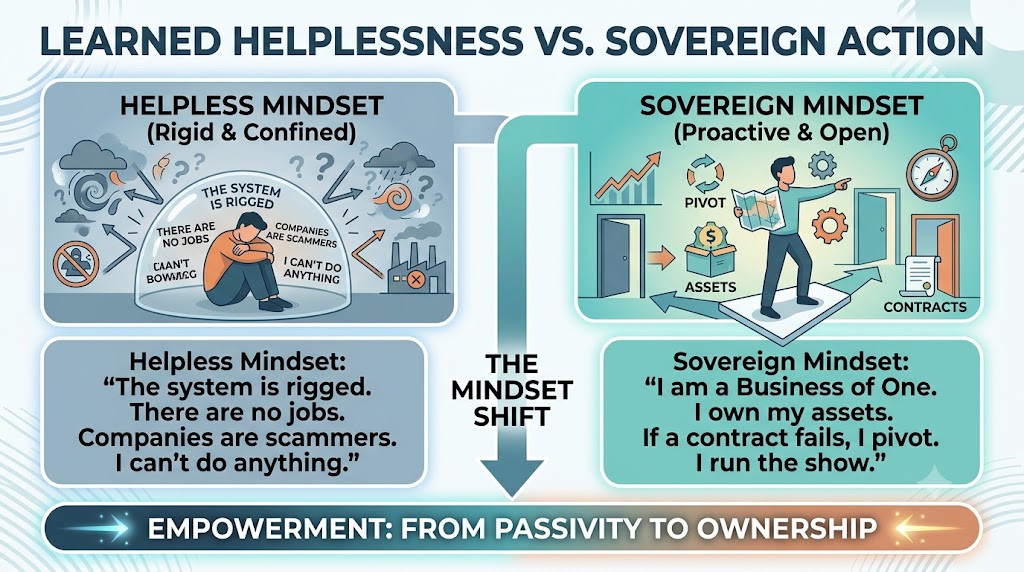
Modern employment operates on the exact same psychological principle.
We watch our colleagues get laid off, we watch our real wages stagnate against inflation, and we watch platforms arbitrarily cut our compensation rates. Instead of building our own assets, launching side-hustles, or diversifying our income, we sit in our cubicles or drive our rideshares, whimpering about how unfair the world has become. We have learned to be helpless.
The self-scammer uses learned helplessness as an excuse for inaction. They say: "I would start my own business, but I need health insurance." Or "I would build a portfolio, but I don't have the time."
These are not logical statements; they are the comforting whispers of your internal con artist, convincing you to stay in the locked cage because stepping out into the open air of self-reliance is too terrifying.
The Sovereign Professional: Becoming Un-Scammable
If you want to stop being scammed, you must stop being a scammer to yourself. You must refuse to trade your ultimate human sovereignty for a counterfeit safety net.
Even if you choose to work within a traditional corporate structure, you must shift your mindset from a dependent employee to a Sovereign Professional. This shift requires three radical commitments:
1. Own Your Risk and Your Reward
Stop looking for a corporate savior. Accept that your current employer does not owe you a future, a career path, or financial security. You are an independent enterprise. If you are not actively building your own assets, your own network, and your own skills, you are choosing vulnerability.
2. Treat Employment as a Client-Vendor Relationship
A business owner does not cry when a client cancels a contract; they adjust their cash flow, analyze their risk, and find a new customer. You must treat your employer the exact same way. They are not your "family," they are not your protector, and they do not own you. They are a single client renting your services. If they breach the contract or mistreat you, you do not play the victim. You execute your pre-planned exit strategy.
3. Build Your Sovereign Safeguards
Do not sign any professional agreement without having your safeguards in place. This means maintaining multiple income streams, keeping your personal brand active outside of your employer’s ecosystem, and holding a robust financial buffer that allows you to walk away from any toxic deal without blinking.
Stop Running the Con on Yourself
The next time you feel the sting of corporate betrayal, the pain of a slashed gig rate, or the cold reality of a sudden restructuring, do not waste a single second screaming about "scammers."
Take a deep breath. Stand in front of the bathroom mirror. Look directly into the eyes of the person looking back at you, and have a hard, honest conversation.
Admit that you allowed yourself to become vulnerable. Admit that you traded your career sovereignty for the illusion of safety.
And then, make the uncompromising choice to take your power back. You are not a helpless victim in someone else’s corporate game. You are the CEO, the founder, and the sole owner of the most important enterprise in the world: Yourself. It’s time to start acting like it.
Take the Next Step: Intervene on Your Self-Scam
Are you ready to expose the internal con artist and stop running the self-scam?
To help you break through the psychological defense mechanisms that are keeping you trapped in voluntary dependency, we have created The Employee-to-Sovereign Mindset Shift Workbook.
This highly actionable, interactive digital workbook contains 5 critical diagnosis exercises, reframing templates, and an accountability action plan to help you reclaim your internal locus of control and start operating as a true Business of One.
[Click here to download your FREE Mindset Shift Workbook now.]